
The woman in the salon chair kept twisting the fragile ends of her hair, as if the answer might be hiding there. “I’m 64,” she said quietly, “but every haircut makes me look either far older or too forced.” Around her, dryers buzzed and foils crinkled, while other women watched through mirrors with the same unspoken doubt. The real question wasn’t about age at all. It was about how to look like yourself today, not a tired version of the past. The stylist smiled, lifted a section toward the light, and replied that years of habit were weighing her down. What followed made the entire room lean closer.
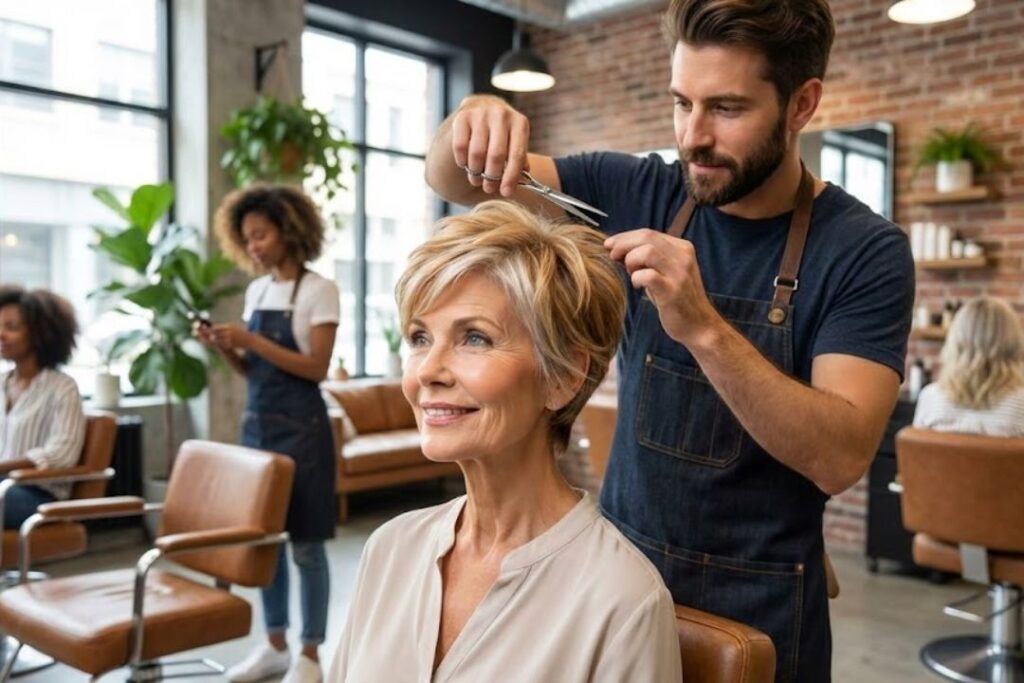
The Haircut That Softly Takes Years Away
Ask seasoned hairstylists what truly refreshes a woman’s look after 60, and the answer is strikingly consistent: a modern layered bob. Not the rigid, helmet-like cuts of decades past, but an airy shape with natural movement and softness. It grazes the jaw or brushes the shoulders, highlights cheekbones, and leaves gentle pieces framing the face. The effect is subtle yet powerful. You notice the eyes first, then the smile, then the energy. The haircut doesn’t announce itself. It simply lets the woman step forward.
A Client Story Stylists Never Forget
A London stylist once described a 68-year-old client with hair falling to mid-back. It had been her comfort shield since the 1980s, but thinning ends and constant tying pulled her features downward. He suggested a soft bob just below the jaw with a light side fringe. After weeks of hesitation, she agreed. When she saw the mirror, she whispered that she looked like herself again, only less exhausted. Later, her daughter messaged in disbelief, saying she looked ten years younger without knowing why.

Why This Bob Looks So Youthful
The logic behind this cut is simple. With age, hair often loses density at the ends, especially when worn long. Those fine lengths read as flat and dated. A layered bob removes the weakest sections and concentrates volume closer to the face, creating a lifting illusion. Soft layers add motion, easing harsh outlines and complementing skin that has naturally softened over time. In many ways, the haircut begins doing the visual lifting that skincare alone struggles to achieve.
How to Ask for the Most Flattering Bob
Start with length. For most women over 60, the ideal point sits between the chin and collarbone, never slicing straight across the widest part of the neck. Request a shape that angles slightly forward, longer in front than in back, to avoid a boxy jawline. Emphasize internal softness rather than choppy steps, and ask for fine pieces around the face so the look stays gentle instead of severe.

The Role of Fringe and What to Avoid
Many stylists agree that a light, wispy fringe or side-swept bang is the real rejuvenating detail. It softens the forehead, draws attention to the eyes, and avoids looking like concealment. Heavy, blunt bangs tend to feel outdated, while overly short ones expose every styling slip. Professionals also caution against keeping the length just a bit too long out of hesitation, which can cause awkward flips at the shoulders. Similarly, a single dark shade can flatten the look, while soft dimension or natural silver with brighter face-framing pieces adds light and vitality.
Living With the Cut in Real Life
The true success of this bob appears weeks later, not on salon day. Women love that it still falls into place with minimal effort, looking intentional rather than accidental. Stylists recommend a small amount of root lift, light blow-drying at the front, and letting the back behave naturally. On slower days, air-drying with a touch of cream is enough. A well-built bob does more work than any brush. It fits real life, not magazine perfection.
A Quiet Shift in How Women See Themselves
One senior stylist sums it up simply: the goal isn’t to look younger, but to look like the woman you still feel like inside. This haircut represents a quiet change, trading nostalgia for clarity. What falls to the salon floor isn’t just hair, but outdated habits and old expectations. The bob is merely the prop. The real transformation shows in posture, confidence, and the way a woman walks back into her life.

Key Elements Stylists Focus On
- Ideal length: Between chin and collarbone, slightly longer in front to maintain lift and softness
- Layering and movement: Subtle internal layers with gentle texture for natural volume
- Fringe and framing: Light or side-swept fringe with face-framing pieces to soften features
